Don't quit on the beach
Jul 22, 2026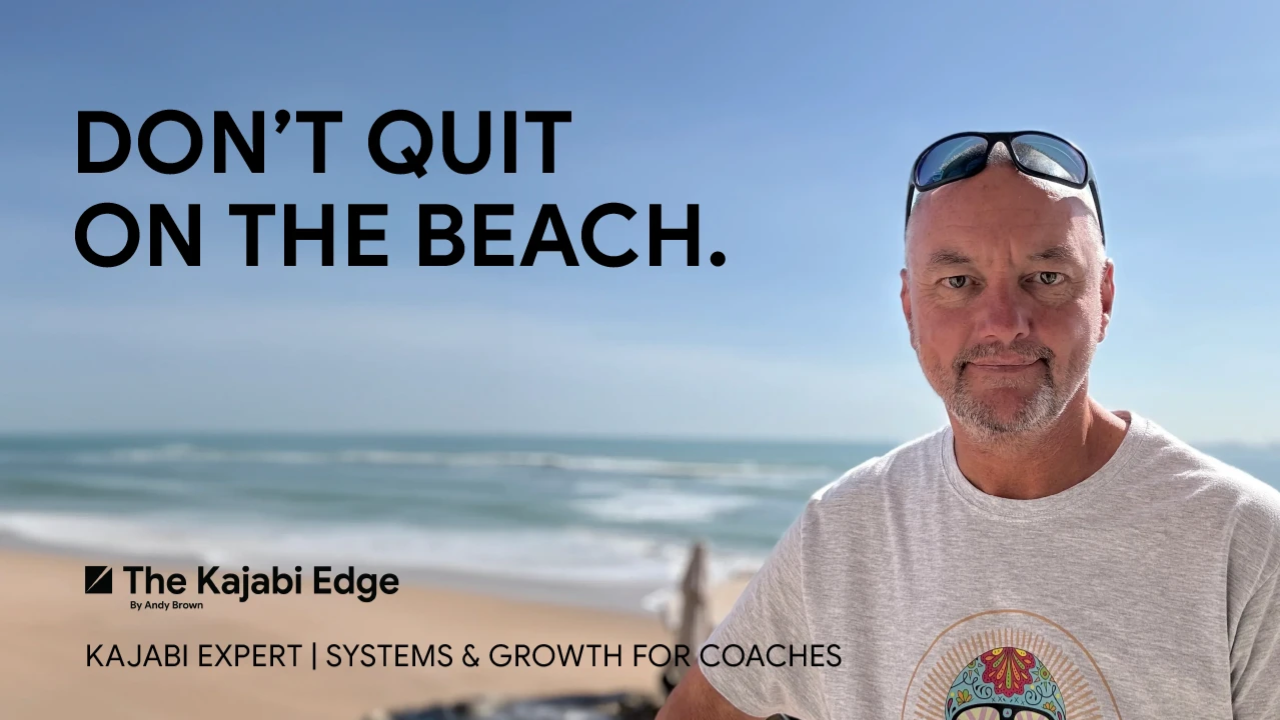
By Andy Brown | The Kajabi Guy · 3 min read
Every summer, like clockwork, the same thought does the rounds among coaches who've knocked off for a well-earned break.
They're a week in, far enough from work to hear themselves think, and somewhere in all that stillness, the same quiet voice starts up and won't leave them alone. I'm not sure I want to do this any more.
Nobody really warns you about this part when you start out. Coaching is genuinely exhausting. I know for a fact that if I do three calls in a single day I'm toast, and that's only three. So when you're doing it full-time, week in and week out, a proper break stops being a luxury and becomes the only time you ever get to breathe and actually think.
The trouble is that the sudden shock of stopping can make the whole business feel like more than you ever want to pick back up. You go from full tilt to a dead stop, the silence rushes in, and from inside that silence the running of it all looks impossibly heavy, until the thought finally creeps in that maybe you just don't want to do this any more.
Before you cancel the return flight home and start selling coconuts on the beach, let me tell you something. That voice is rarely telling you the truth.
The question that matters isn't whether you want to quit
Tired people always want to quit. On a Friday afternoon, in the dead of February, three days into a launch that won't convert. The urge to walk away is not a reliable signal, because it turns up whenever you're running low, and it goes just as quickly once you've slept.
The real question is far more specific. It isn't whether you want out of the whole business, it's which part of it you no longer want to do. And once you ask it that way, you almost always find it was never the whole thing.
Because exhaustion doesn't come only from the hours. Far more of it comes from the parts that no longer fit. The content treadmill you've come to dread. The one client who leaves you flat every single time. The offer you outgrew two years ago. The niche that suited the old you and quietly stopped suiting the person you've become. The assistant who drains more energy than they give back.
Pull that single thread out, and more often than not, the urge to walk away from all of it loosens and goes with it.
A pivot and a quit are not the same thing
That difference has a name. Changing direction in business without giving up is called a pivot, and it has a precise meaning. Eric Ries, who popularised the term, defined it as a change in strategy without a change in vision. He took it from basketball, where a player keeps one foot planted and moves the other to find a better angle. You don't leave the court. You keep one foot on everything you've learned and swing the rest of you towards a better position.
A quit is a different thing entirely. A quit walks away from everything, the court included. A pivot keeps what still works and changes what doesn't.
And the hard truth is you can't tell which one you actually need while you're lying on a sun lounger running on empty. That's the worst possible moment to decide.
We're taught to grit our teeth, and it costs us
There's a reason so many coaches sit on that decision far too long. We've been raised to treat quitting as failure and grit as the virtue. Stick it out. Push through. Never give up.
Grit has its place, but it isn't the whole story. Annie Duke, who has written well on this, makes the point that quitting and grit are two sides of the same decision. We tend to hang on long past the point of sense, not because the evidence says carry on, but because we've already put so much in that walking away feels like waste.
And the hardest thing of all to give up is never the work. It's the identity. "I'm a [whatever] coach" becomes who you are, not just what you do, and the moment you consider changing it, your brain reads it as quitting on yourself. It isn't. You can keep the vision and change the vehicle. The reason you started, helping people get from where they are to where they want to be, doesn't have to move an inch. The niche can change. The format can change. The sort of client can change. The destination stays exactly where it is. You're only changing the route.
I once watched someone walk away from a coaching business with real potential, not because the potential wasn't there, but because they couldn't feel it from where they were sitting. They didn't pivot. They quit the lot. Years on, I still wonder what that might have become for them.
The coach with no one to ask the question back
Here's the part that gets me. Coaches do this for other people for a living. Someone sits across from you, convinced the whole thing has to come down, and you're the calm voice in the room who helps them see it's just one fixable piece, not their entire life's work.
The problem is that nobody is sitting across from you. The coach on the beach, quietly talking themselves into packing it all in, has no one there to ask the obvious question back.
Be your own client
So be your own client for a minute. Don't make a call this big from the lounger, tired and a couple of margaritas in. Wait until you're rested and back in the swing of it, then do the very thing you'd have a client do.
Write two honest lists. One for everything you'd keep, and one for everything you'd happily never do again.
That second list isn't your reason to quit. It's your pivot, the part you change, drop, or hand off. The keep list is the one that decides it. If it comes back genuinely empty, then fair enough. That's real, and you can walk away with a clear conscience. But most of the time it won't be empty, and most of the time the thing you were ready to quit turns out to be a pivot in disguise.
Tired is not the same as done.
Andy Brown | The Kajabi Guy
Verified Kajabi Expert. I help coaches and training companies build growth systems. 20+ years in business strategy and brand & marketing.
UK-based, working with clients worldwide.
great-circle.co.uk
If you've come back from a break and the doubt hasn't lifted, that's worth taking seriously. Just not alone, and not on a bad day. Sometimes all it takes is one honest conversation with someone who isn't attached to the answer to work out whether you're looking at a pivot or a full stop.
Here are two ways I can help when you're ready.
1:1 Strategy with Andy. For once, you get to be the client. You bring the business and the doubt, I bring 20+ years of seeing what's worth keeping and what isn't, and we work out together which parts to change and which to leave well alone. Book a strategy session.
Done-for-you Kajabi build. Once you know what you're keeping and where you're headed, I'll build the systems that carry it, courses, memberships, funnels and automations, so the business runs without running you into the ground. See how it works.
Frequently Asked Questions
How do I know whether to pivot or quit my coaching business?
Write two lists: everything you'd keep, and everything you'd happily never do again. The "never again" list is your pivot, the parts to change, drop or hand off. The keep list decides it. If it comes back genuinely empty, quitting is honest. If it doesn't, you're looking at a pivot, not a quit.
Why do I suddenly feel like quitting my coaching business?
Most often it's fatigue rather than a genuine decision. The urge to quit surfaces whenever you're depleted, particularly after the sudden stop of a break. It usually points at one draining part of the business rather than the whole thing, and it tends to fade once you're properly rested.
Is it normal to want to quit coaching after a holiday?
Very. Stopping suddenly after months at full tilt makes the whole business feel heavier than it is, and the quiet gives that doubt room to grow. It's common, it's rarely the truth, and it's the worst possible moment to make a decision you can't easily undo.
What is the difference between a pivot and a quit?
A quit walks away from everything. A pivot keeps what still works and changes what doesn't, a change in strategy without a change in vision. You keep the destination, helping people get where they want to go, and change the route: the niche, the offer, the format, or the type of client.
Should I make a big business decision while on holiday?
No. Tired, distant and a couple of drinks in is the worst state to decide anything you can't reverse. Sit with it, write your two lists, and come back to it once you're rested and back in the work. If the doubt is still there when you're fresh, then it's worth taking seriously.